JAPANESE, ONE USEFUL IDEA AT A TIME
Better Japanese Anki cards: keep the context, shrink the question
Turn an overloaded Japanese flashcard into a clear recall task, with original examples and a practical rule for editing frustrating cards.
Turn an overloaded Japanese flashcard into a clear recall task, with original examples and a practical rule for editing frustrating cards.
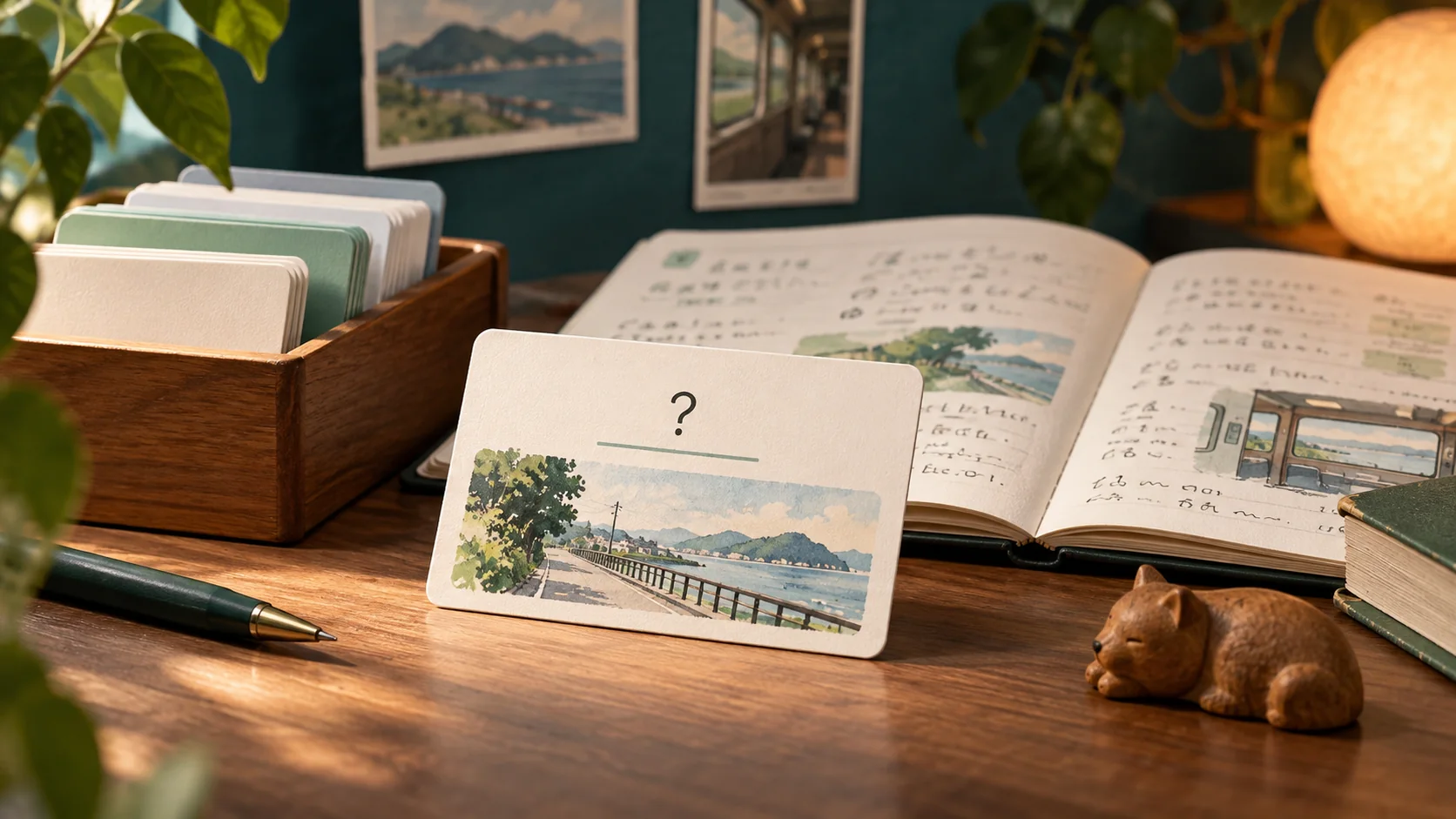
A Japanese flashcard can become a tiny storage unit: five meanings, three readings, a screenshot, a grammar note and a sentence you never liked. Then you press “Again” because you cannot remember what you were supposed to answer. The card has plenty of information. The question needs work.
Start by choosing one job for the front of the card. Are you trying to recognize a word in a sentence, recall a reading, or produce a phrase for a situation? Those are different tasks. Combining them makes it hard to know whether an answer was actually correct.
Keep enough context to choose the meaning
Here is an original sentence: この店は駅から近いです。 “This shop is close to the station.” A recognition card could show the sentence and highlight 近い. The target answer is the meaning that fits here: close or nearby. You do not need to recite every dictionary entry for the word.
A separate reading card could ask for 近い in that same sentence, with ちかい on the answer side. If the reading is your target, do not put its furigana on the front. If meaning is your target, furigana may be helpful support. Make that choice intentionally instead of letting the template choose the skill for you.
Make the answer easy to judge
Write a short expected answer and one useful explanation on the back. For the example, the explanation might say that 駅から identifies the reference point: close to the station. Keep a source link or your own sentence note if you will need to check it later.
A production prompt needs tighter boundaries. “Say something about a shop” allows too many answers. “Politely say that this shop is close to the station” gives you a usable target, while still allowing natural alternatives. Decide what counts as correct before the review starts, and do not punish a valid equivalent just because it differs from the wording on the back.
Edit the card when the question keeps failing
When you repeatedly miss a card, check whether the sentence is understood, the prompt is ambiguous, or the information is too crowded. Correct the card before adding more repetitions. Temporarily setting aside a confusing item can give you room to learn the underlying idea properly.
The official Anki study guide explains review controls and grading. Follow the guide for the app's mechanics; this article's card-design examples are original suggestions, not a promise that a particular format guarantees retention.
Keep the example short enough that the target remains visible. A full paragraph can be useful reading, but it may ask for more attention than you intended during a quick review. Move extra background into an optional note on the answer side.
Try rebuilding just three cards today. Use sentences you understand and actually want to remember, then check tomorrow whether you can explain what each front is asking. You can draft an original example in Language IDE before moving it into Anki. A smaller, clearer question is often the most useful upgrade available.
日本語のAnkiカード:文脈を残し、質問を小さくする
日本語のカードに意味を五つ、読みを三つ、画像、文法説明まで入れると、情報は増えても質問が分かりにくくなります。まず、表で何を答えるかを一つ決めましょう。文中の意味を理解する練習、読みを思い出す練習、場面に合う文を作る練習は別の課題です。
意味を選べる文脈を残す
練習用の文は「この店は駅から近いです」です。「近い」を目立たせて意味を尋ねるなら、この文での意味が答えられれば十分です。辞書のすべての意味を並べる必要はありません。
読みを練習する別のカードなら、表に「近い」、裏に「ちかい」を置きます。読みが課題なら、表に答えのふりがなを出さないようにします。意味が課題なら、ふりがなを補助として使ってもかまいません。テンプレート任せにせず、目的に合わせて選びます。
答えの判断を簡単にする
裏には短い答えと、役立つ説明を一つ置きます。例えば「駅から」は距離の基準を示す、という説明です。後で確認できるように出典や自作の例文であることも記録します。
文を作る課題では「店について何か言う」より、「この店が駅から近いことを丁寧に伝える」の方が明確です。自然な別の言い方もあるので、裏と一字一句同じでないだけで不正解にしないよう、判断の基準を先に決めます。
繰り返し失敗するならカードを直す
文を理解しているか、質問が曖昧ではないか、情報が多すぎないかを確認します。繰り返す回数を増やす前に、カードを直しましょう。分からない内容を学び直す間、そのカードを一時的に休ませても大丈夫です。
例文は課題が見える長さにします。長い段落は読解には使えても、短い復習には負担になるかもしれません。補足は裏の任意の説明に移せます。
操作や評価の方法はAnki公式の学習ガイドで確認できます。今日は三枚だけ作り直し、明日も質問の目的が分かるか確かめます。自分の例文はLanguage IDEで準備してもよいでしょう。ここでのカード例は独自の提案で、記憶の効果を保証するものではありません。
Put this idea into practice
Keep reading
DiccionarioJaponés.com: a useful Japanese–Spanish companion from Matías Acosta
A shoutout to Matías Acosta, plus a practical way to turn a Spanish dictionary lookup into Japanese you can actually use.
Read a Japanese Release Note and Say Exactly What It Claims
Work through one real VOICEVOX 0.26.1 entry and paraphrase it in English or Spanish while keeping the changed parts and the stated purpose.
Babbel for Spanish practice: useful structure, with one important language gap
Babbel offers Spanish courses, not Japanese. Here is how I would evaluate its place in a multilingual study routine.