JAPANESE, ONE USEFUL IDEA AT A TIME
DiccionarioJaponés.com: a useful Japanese–Spanish companion from Matías Acosta
A shoutout to Matías Acosta, plus a practical way to turn a Spanish dictionary lookup into Japanese you can actually use.
A shoutout to Matías Acosta, plus a practical way to turn a Spanish dictionary lookup into Japanese you can actually use.
If you study Japanese through Spanish, you know the extra mental hop: Japanese word, English explanation, Spanish meaning, then back to the sentence. Sometimes that works. Sometimes you just want a clear explanation in the language you actually think in. That is why I wanted to give DiccionarioJaponés.com, from Matías Acosta, a shoutout. He reached out and invited me to look at it. I like it, and I think it makes a useful supplement for our readers.
The useful part is what happens after the lookup. A dictionary gets you unstuck; a small reading and writing loop helps the word become yours. Here is a way to combine the site with Manabi Kōbō without turning one unfamiliar sentence into an afternoon of open tabs.
Start with the sentence that confused you
The site presents Japanese–Spanish lookup, readings, kanji information and sentence-analysis tools. Its homepage also advertises searches using conjugated forms. Those are helpful entry points, but a search result still needs the surrounding sentence. A word can have several senses, and the first Spanish gloss is not automatically the right one.
Try this original example: 昨日は家で本を読みました。 It means “Yesterday I read a book at home.” If 読みました is the obstacle, look up that form, then connect it with 読む. Keep both in your note: the dictionary form lets you recognize the word elsewhere; the sentence shows how it behaves here. Notice that the polite past ending belongs to the verb. It does not change who read the book.
Compare two uses before saving anything
Now change only the object: 昨日は家で記事を読みました。 “Yesterday I read an article at home.” You did not learn an entirely new sentence. You reused a structure and replaced one piece. That is a much more useful check than copying five unrelated translations.
For a Spanish learner, write the meaning naturally: “Ayer leí un artículo en casa.” Do not force Japanese word order into Spanish just to make the lines match. Instead, mark yesterday, at home, article and read as corresponding chunks. The languages can say the same thing while arranging the information differently.
A lookup card that earns its place
Make the front of a practice card a situation: “Tell a friend what you read at home yesterday.” Put your Japanese sentence on the back, with a reading for the unfamiliar kanji and one short usage note. A card that only says “read = 読む” leaves out the decision you actually need to practice: how to build the sentence.
Before keeping the card, answer three questions. Which meaning fits this context? Which part changes for present versus past? Can I say a different true sentence with the same pattern? If one answer is fuzzy, keep the example in a scratch note and revisit it. There is no prize for importing a huge deck you will never want to review.
Bring the word back to your reading
Return to the original paragraph and read it once without stopping. Then use our Sentence Builder for another sentence-pattern exercise, or continue with the Side by Side Reader. The point is to reconnect the dictionary result to a message, not to memorize the entire dictionary entry.
My practical limit would be three useful lookups in one short session. Keep a separate “interesting later” list for everything else. If every unknown word becomes urgent, reading stops feeling like reading. Pick the words that unlock the paragraph or help you say something you care about.
Try this small challenge
Look up one word from something you genuinely want to read. Write one original Japanese sentence, a natural Spanish version and a second Japanese sentence with one detail changed. Tomorrow, cover the Japanese and try to rebuild it. If you can explain why you chose that word, the lookup did its job. Thanks, Matías, for building another useful place for Spanish-speaking learners to explore Japanese.
Reference: DiccionarioJaponés.com. Feature descriptions reflect its public pages checked in October 2026; this article is a learning workflow, not an exhaustive technical audit of the dictionary.
マティアス・アコスタさんのDiccionarioJaponés.comを学習の味方に
スペイン語で日本語を勉強していると、日本語の単語を英語で調べ、それをスペイン語に置き換えてから元の文に戻ることがあります。それで十分な日もありますが、自分が考える言語で説明を読みたい日もあります。そこで紹介したいのが、マティアス・アコスタさんのDiccionarioJaponés.comです。本人からサイトを見てほしいと連絡をもらいました。私は気に入っていますし、読者の皆さんにも役立つ補助教材だと思います。
大切なのは、調べた後に何をするかです。辞書は行き詰まりを解消してくれます。そこに短い読み書きの練習を加えると、単語を自分で使えるようにできます。知らない一文のために何時間もタブを開き続けずに、Manabi Kōbōと組み合わせる方法を紹介します。
分からなかった文から始める
このサイトには、日本語とスペイン語の検索、読み方、漢字情報、文の分析ツールがあります。ホームページでは活用形での検索も案内されています。ただし、検索結果を読むときも前後の文は必要です。単語には複数の意味があり、最初の訳語が必ず合うわけではありません。
オリジナルの例文「昨日は家で本を読みました。」で試しましょう。「読みました」が分からなければ、その形を調べて「読む」と結び付けます。両方をメモしましょう。辞書形は別の文章で単語を見つける助けになり、例文は今回の使い方を示します。丁寧な過去を表す語尾は動詞の一部であり、本を読んだ人を変えるものではありません。
保存する前に二つの使い方を比べる
目的語だけを変えます。「昨日は家で記事を読みました。」まったく新しい文を覚えたのではなく、同じ構造の一部を入れ替えたのです。無関係な訳を五つ写すより、使い方を確かめやすくなります。
スペイン語では「Ayer leí un artículo en casa」のように自然に書きます。左右の行を合わせるために日本語の語順を押し付ける必要はありません。「昨日」「家で」「記事を」「読みました」の意味のまとまりを対応させましょう。情報の並びが違っても、同じ内容を伝えられます。
残す価値のあるカードを作る
カードの表には「昨日、家で何を読んだか友達に伝える」という場面を書きます。裏には日本語の文、知らない漢字の読み方、短い使い方のメモを置きます。「leer=読む」だけでは、文を組み立てる判断を練習できません。
保存前に三つ確認します。ここではどの意味が合うか。現在と過去では何が変わるか。同じ型でもう一つ本当のことを言えるか。曖昧なら下書きに残し、後で確認すれば大丈夫です。復習したくない巨大なデッキを作る必要はありません。
調べた単語を元の読書に戻す
元の段落に戻り、一度止まらずに読みます。その後、Sentence Builderで別の型を練習するか、Side by Side Readerで読み続けましょう。目的は辞書の説明を丸暗記することではなく、単語を伝えたい内容に結び付けることです。
短い一回の学習なら、役立つ検索を三つまでにするのがおすすめです。ほかは「後で調べたいこと」に入れます。知らない単語を全部急いで調べると、読書そのものが進まなくなります。段落を理解する鍵になる語や、自分が言いたいことに使える語を選びましょう。
小さな課題
本当に読みたい文章から一語を調べます。自分で日本語の文を書き、自然なスペイン語訳を付け、内容を一つ変えた日本語の文も作ります。翌日は日本語を隠して再現してみましょう。その単語を選んだ理由を説明できれば、検索が学習につながっています。スペイン語話者が日本語に触れられる場所を作ってくれたマティアスさん、ありがとうございます。
参考:DiccionarioJaponés.com。機能の説明は2026年10月に確認した公開ページに基づきます。この記事は学習手順の提案であり、辞書全体の技術監査ではありません。
Put this idea into practice
Keep reading
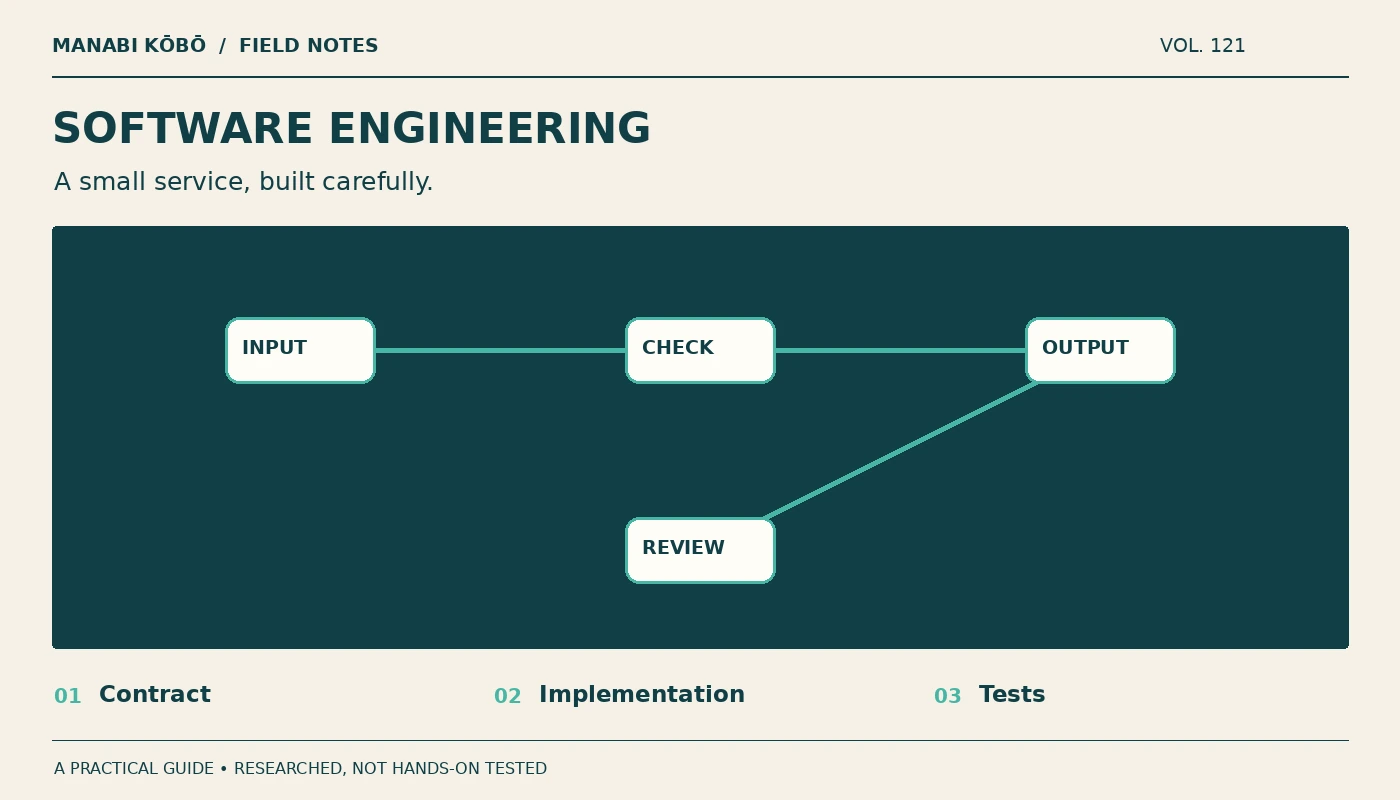
A Python bootcamp should leave you with a tool someone else can run
Assessing a software engineering bundle through a small command-line tool, reproducible setup and restrained concurrency.
Koofr for a study archive: test the restore before you fill the terabyte
A practical assessment of cloud storage for notes, recordings and project exports, with a small restore drill.
ChatPlayground AI: compare answers without confusing agreement with evidence
A model-comparison workspace can save copying, but a useful review still needs known answers and a clear privacy boundary.